

How to build a Cricket Table, is a basic guide in terms of considerations with a generic specification based on ECB guidance. I also write briefly in terms of feasibility. The aim of the blog is out of interest and also to highlight the need to explore the feasibility of such a project.
There is very little online in regards to building a cricket table and that’s also probably wise, every ground, every site is unique only with outside expert assessment should such a project be considered. A poorly performing cricket table, can be down to a multiple issues and relaying could well be not needed.
Blog written by Brian assisted most generously by Keith Exton of Perfect Pitches UK
Starting Point –Feasibility
These are just a few points worth considering before proceeding any further-
What is your lease term, is this a viable project in 10-15 plus years?
Can you source external funding, do you tick the boxes needed in funding routes, club mark club etc?
Do you have a trained grounds team who can meet the demands of additional pitches?
Is your current square fitting your needs, is any outlay sustainable?
If doing a full cricket table/square construction, can you not play on it for 18 months as often required in the creation of new surfaces?
Consider you may need to update your watering capabilities to the square, as often required in new square constructions?
Are there less invasive projects instead, as an example just removing the top 1-2 inches, rather than a full construction, with a long settlement period?
Who is going to manage the project?
Construction materials such as loam choice, is this a sustainable and suitable product for the standard of cricket and the limitations of covers. A higher clay content takes longer to dry out after rain/irrigation and is the loam you’re considering using compatible with the existing soil, more of an issue in shallow constructions.
Are there underground drainage systems that maybe need to be redirected at cost?
What size of table/square do you need, also need to factor in the ongoing maintenance and renovation costs of each pitch, if adding more pitches that you currently have?
Who is going to put together a specification of works, this type of project is usually beyond the experience of your current groundsperson.
Rather than adding a pitch or two, are hybrid pitches a feasible option?
Construction Considerations
Depth of construction, this can come down to the standard of cricket, the compatibility of existing soils and what soil your current table/square sits on. As an example, if the base is on sand you are more likely to need deeper construction and or possibly a stone/gravel base.
Cost to remove subsoil/topsoil may need to be factored in.
It is a common misconception that people think that the area for construction is reasonably level, it’s not until you put a laser on it that you might find it is not a grade that is acceptable within the ECB guidelines.
This is not insurmountable at finish levels, but it does add to the workload, and additional costs for materials to blend the new construction into the outfield with acceptable gradients.
Having laid squares with string line, steels, and a spirit level in the past, i would not even attempt a construction now with out the laser technology, what you think is a good level with the old method, is miles out when you put a laser on it.
Keith eXTON- pERFECT pITCHES
A ring main drain installation is more than likely required for raised squares or water run-off will sit on what will be bowlers run ups, and games could be delayed for safety reasons for bowlers, and of course if flat sheets are used, even more reason for quick drainage points to be installed.
Additional pitches added to a square can be very challenging to get right, so many factors that may be incurred, and two years till final settlement.
If laid on a firm chalk subsoil, then a shallower construction could be possible.
Newly constructed cricket tables/squares should be constructed around 25mm proud of the outfield, this prevents water run on from the outfield there should also be a gradient so water can run off the area and does not sit in a pond. If adding pitches to an existing square, this is unlikely to be the case.
You can employ the services of a consultant who can work with you on all the above, including the overseeing of work, these services are not cheap on the face, but don’t underestimate such a project.

Basic Construction Guidelines
Also check out this for Basic Construction Guidance via the ECB TS4 document on the Construction, Preparation and Maintenance of Cricket Pitches and Outfields. Link – https://www.ecb.co.uk/be-involved/club-support/club-facility-management/surface-types
Basic Guidance on Construction Depths
Drainage – 100- 200 mm depth
Sub base – 100- 150 mm depth
Top soil – 50- 150mm
One
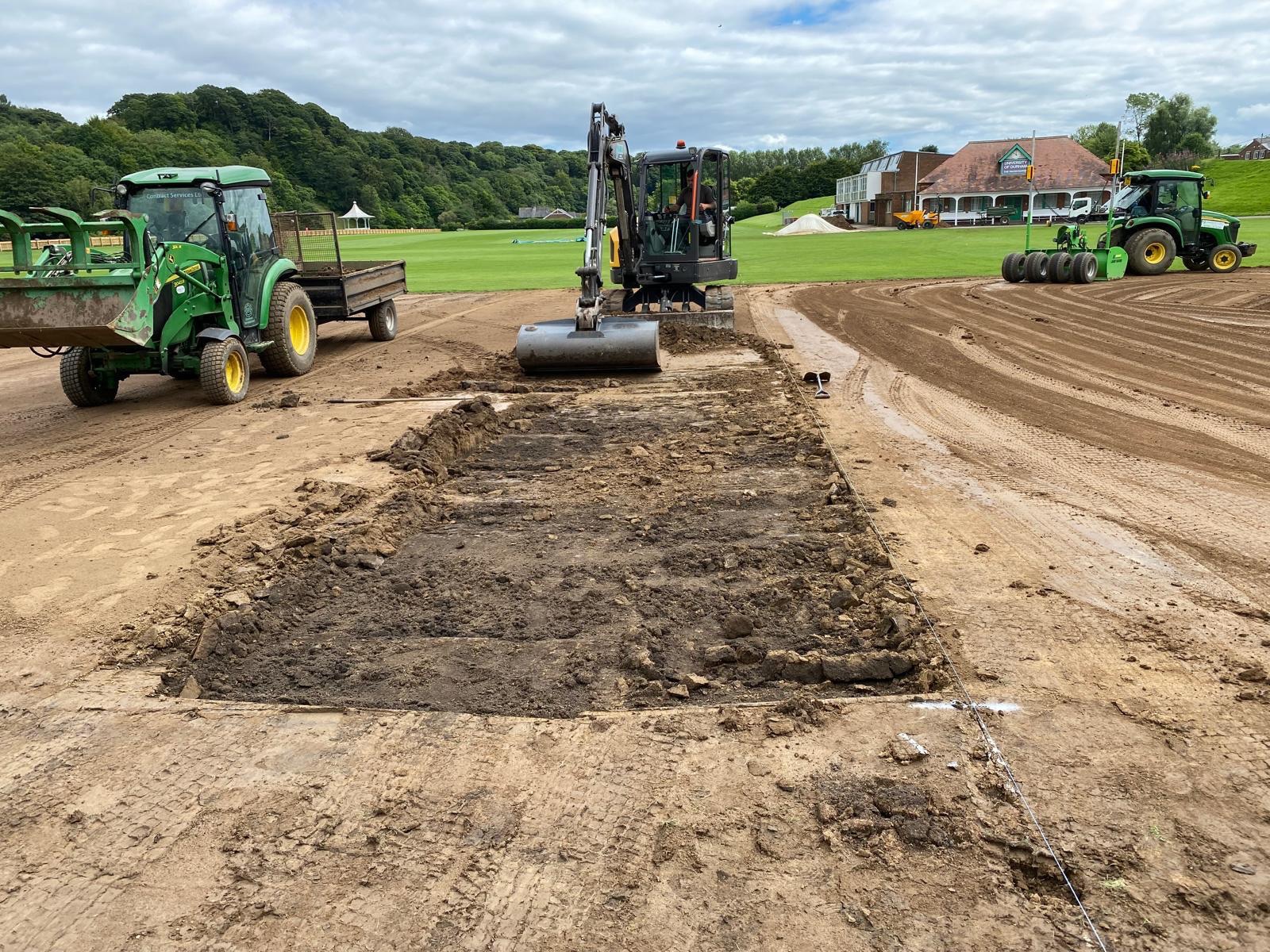
Measure out the area followed by excavations, in suitable ground conditions to minimise damage to outfield areas. Remove topsoil/subsoil to agreed depth and graded level base.
Topsoil/Subsoil may be able to be reused, if compatible with the topsoil/loam you bring in.
Two
If drainage is planned as part of the project or the inclusion of a gravel/stone base material, this should be added, levelled and firmed at this stage.
Three
Sub base if depth of construction is deeper than 100mm, this is done by adding of a loam, often screened to 8-10 mm. This should be added in 50 mm loam layers and then graded by means of laser guided technology or string lines or rail/shuttering.
Four
Consolidation of the layer by means of heeling or at worst wheels tracks and then lightly rake to create a key between layers. Consolidation is key to success so ensure this is done thoroughly/intensely.
Loams used at this point need to be compatible with the topsoil (loam) you are planning on using.
Five
Continue to build up the subsoil in 50mm layers at a time, until you are in the top soil zone 50-150mm from the top of the excavation. The last 50-150 mm of loam should be a finer screened loam to 4/5mm ensuring extra care with, levelling, firming and raking at this vital stage of work.
Ensure it was pre planned that you will finish 25 mm (subject to agreed spec) above the outfield on a full construction or if only adding an extra pitch, then a finished level of a few millimetres above the existing pitches. Settlement is dependent on a few factors, so needs to be talked through post works with your construction contractor.
Six
If not done so, rake the consolidated final levels, impacting the soil to a few millimetres in depth and seed, possibly with the use of a cyclone spreader with a cricket specific ryegrass mix at 70-100 grams a square meter. Finish with the application of a pre seed fertiliser, containing a high percentage of phosphorus such as a 6-9-6 NPK analysis granular feed.
Fence off and keep the area moist to allow for germination and possible use of germination sheets or fleece.
Disclaimer- The Above guide is for a basic understanding, not as a how to guide to follow, l would strongly recommend the use of a sport turf construction specialist for such a project.

Getting it Wrong
Root breaks/layering which could affect pitch performance for years to come and be costly to rectify.
Level issues, ponding and water unable to drain away from the cricket table.
Long term settlement issues, choosing the wrong loam or not consolidating well enough.
Specialist Contractor
Although it is possible to do inhouse, l personally believe there are too many factors involved in doing yourself, l would seek three quotations from reputable sports ground construction specialists.
The aim of the blog is out of interest and also to highlight the need to explore the feasibility of such a project. l also hope by building up a basic understanding of what is to be considered will prevent any quick fix unsustainable project
Blog written by Brian assisted most generously by Keith Exton of Perfect Pitches UK
New to TurfCareBlog.com why not check out out cricket archive page


3 comments
I would like to make a comment from my experience of having a new second square laid with ECB funding.
1. It had to be constructed by a ECB approved contractor.
2. It had to be constructed to there specifications.
We had a 6 wicket square laid with a stone bass and all the other revenant layers for good drainage
What they also insisted on was a ring drain round the square, and this is where we have had problems with. It allows to much water to be taken from the two outside tracks and all the ends.
This is my opinion for any club constructing a new square.
Have the square constructed with all the correct layers to aid good drainage but don’t have a ring drain round it, unless you have the man power and a good water supply to keep it watered. If you don’t you will end up with cracks and grass under stress all the time.
Hi Brian,
As you know I have done quite a few of these over the years, none of whom have complained about the end result. Most have been playable at the start of the following season. I don’t doubt the knowledge base of the ECB and Keith Exton ( huge respect Keith), but this is a huge undertaking for most clubs and mostly over engineered for the quality required and skill level to maintain. Considering the problems you had settling in your new square all those years ago I’m surprised you have forgotten the article and contribution of Chris Wood where he advocates a 100mm construction on undisturbed sub base. A depth I have adopted as well as it suits the affordability.
The trouble with a perched water table base and 200mm of topsoil is the length of time to.establish and the great difficulty managing the water content. This is not what 90% of clubs can cope with. Ie great expense, a season of no play, and a watering/covering requirement beyond most part time set ups.
Great article but it is advocating the absolute top professionally maintained end of the market
I had a quick look for Chris Wood’s article, but couldn’t find it, it may be in Pitchcare somewhere. But I strongly suggest that alongside this article you balance it with the more achievable alternative. Perhaps Chris himself would let you use it.
I still do these ‘push up’ 100 – 125mm builds and the costs run to 10s of 1000s rather than 100s of 1000s! Last full size in use square I did was at locksbottom in Kent and the last new build ( on made up ground!!) Was at Forge Wood in Crawley.
Hope you are keeping well,
Mark
The whole context of the blog is to steer people towards not doing it themselves, each site needs differ as in this text-
Although it is possible to do inhouse, l personally believe there are too many factors involved in doing yourself, l would seek three quotations from reputable sports ground construction specialists.
The ECB guidelines are just to give a ideal of the level of skill involved and would have been put together by Chris Woods as taken from one of his documents, but on getting in quotes and building a spec (ideally spec done before quotes) your be steered to what’s needed on your site within your budget.
The title is click bate but as it’s reads l hope the article is steering clubs away from doing it themselves, as in my opinion it’s specialist work in the assessment and construction of what’s needed, if it’s even needed at all in a under performing square or pitch
Brian